Reading Order Book Depth on PSX Trading Platforms: A Practical Guide
Every modern PSX brokerage app shows a live order book (also called "market depth" or "Level 2 data"): the queue of pending buy and sell orders at each price level. Most retail traders glance at it, don't understand what they're seeing, and move on.
That's a mistake. The order book contains real-time information about buying and selling pressure that can confirm — or contradict — every technical signal you might act on. This guide covers what the numbers actually mean, PSX-specific patterns, and how to combine order book depth with the AI signals from our platform.
What the order book actually shows
On a typical PSX brokerage screen, the order book has two columns:
Left side: BID (buyers waiting)
List of prices where buyers have posted BUY orders, sorted highest to lowest. Each row shows:
- Price: what the buyer is willing to pay
- Quantity: how many shares they want at that price
- Number of orders: how many separate buyers are stacked at that price (some platforms show this)
The TOP of the bid (highest price) is what a seller would immediately receive if they sold at market — the current "best bid."
Right side: ASK (sellers waiting)
List of prices where sellers have posted SELL orders, sorted lowest to highest.
- Price: what the seller wants
- Quantity: how many shares
- Number of orders
The TOP of the ask (lowest price) is what a buyer would immediately pay at market — the current "best ask."
The spread
Best ask minus best bid = the spread. Tighter spread = more liquid stock. On a blue-chip like MCB or OGDC during market hours, spread is typically PKR 0.05-0.20. On a small-cap, spread can be PKR 0.50 or wider — that's already a real cost.
What order book depth reveals
Real supply/demand imbalance
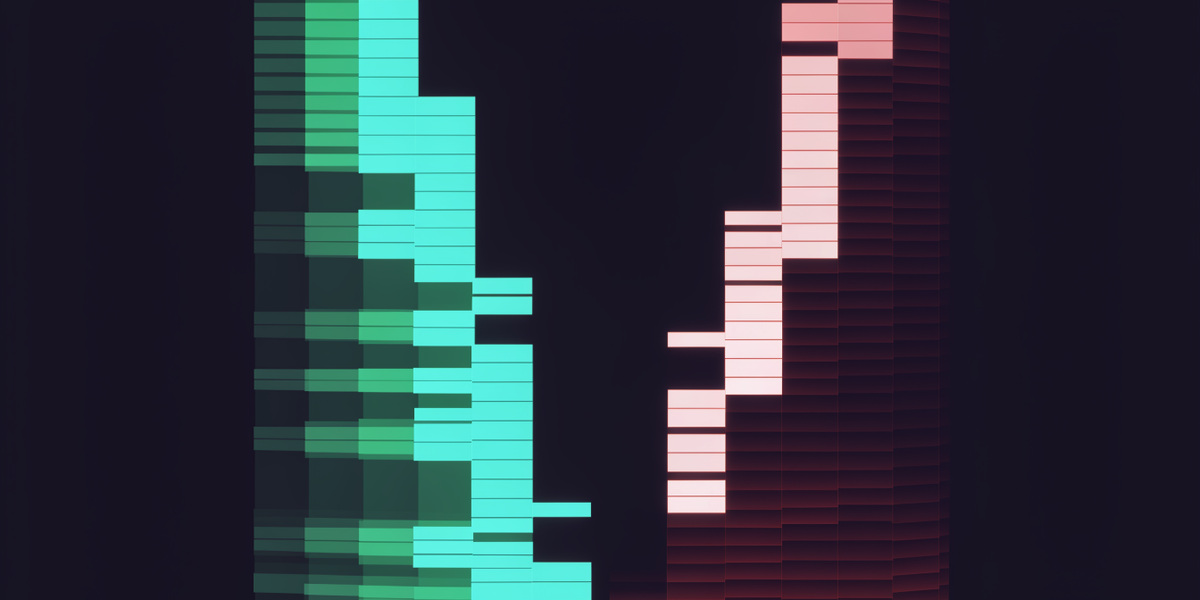
Count total shares waiting on the bid side vs ask side across the top 5 price levels. If bid-side has 500,000 shares and ask-side has 80,000, there's genuine buying pressure. Price likely holds or moves up.
Inverse: ask-heavy book = selling pressure. Price likely drops or stagnates.
Iceberg orders (hidden liquidity)
A large trader who wants to buy 1 million shares won't display all 1M — that would spook the market. Instead they slice into smaller chunks (say 20 orders of 50,000 each) which "refresh" as executed. You spot icebergs by:
- Same price level immediately re-populating with new orders after being filled
- A single institution consistently at the front of the queue
- Order book depth staying similar despite lots of trading activity
Iceberg on the bid = accumulator (bullish). Iceberg on the ask = distributor (bearish).
Circuit-hit queues
When a stock hits upper circuit, the bid queue grows dramatically. Retail traders pile in "trying to catch" the move. The queue depth at UC is misleading — it's not real interest, just hope. Same at LC: massive ask-side queue represents people trying to escape, not sustained selling pressure.
Rule: ignore bid/ask depth data when a stock is circuit-hit. It's noise.
PSX-specific order book patterns
Pre-open queue building
On PSX, the 15 minutes before market open (9:15-9:30 AM PKT) show pre-open queue accumulation. Big pre-open queues on the bid side often indicate morning-gap-up openings. Watch pre-open books for stocks in your watchlist to anticipate the opening move.
Fake orders (spoofing risk)
Unregulated in Pakistan retail: some traders post large fake orders to manipulate perceived depth, then cancel before execution. Signs:
- Very large orders at prices far from current market (e.g., 100k share bid 5% below market)
- Orders that appear and disappear repeatedly
- Depth on one side that suddenly changes without any trades
Don't take order-book depth as absolute truth on illiquid stocks. On heavily-traded blue chips, spoofing has less impact because real institutional flow dwarfs manipulation.
Round-number magnetism
Big order clusters often appear at round PKR levels (100, 250, 500) even when there's no fundamental reason. Retail psychology stacks orders at anchor prices. These clusters act as short-term support/resistance until absorbed.
End-of-day squaring
The last 15-20 minutes of the session (3:10-3:30 PM PKT) often show intense activity as day traders close positions and market makers rebalance. Order book depth patterns can be extreme — don't trade off this window's readings alone.
Combining order book with technical signals
BUY signal (from indicators or AI) confirmed by order book:
- Ask-side thin compared to bid-side
- Growing bid depth as the signal fires
- No large fake ask above current market
= high-conviction entry
BUY signal contradicted by order book:
- Ask-side heavy with orders piled up above
- Bid-side thin
- Recent trades show sellers hitting the bid (down-ticks)
= wait, the signal may not follow through
SELL signal confirmed:
- Bid-side thin
- Ask-side building above current market
- Recent trades show buyers lifting the offer weakly (small size)
SELL signal contradicted:
- Bid-side stable and deep
- Ask-side thin
= the sell signal may be a bear trap
How to use order book on your broker
Most PSX brokerage apps (iSave / KTrade / TPL / Aiwa / others) offer market depth data. Some show it for free, others require a paid tier for Level 2. Check your broker.
When looking:
- Focus on the top 5 price levels on each side. Deeper than that is often stale.
- Read the totals, not individual orders. Sum across price levels.
- Watch for CHANGES, not snapshots. The direction of book evolution (thickening vs thinning) tells you more than any single moment.
- Ignore order book on the first 5 minutes of trading — pre-open imbalances resolve chaotically. Wait for the market to settle.
- Don't rely on order book for illiquid stocks — signal-to-noise is too low.
What NOT to do
- Don't place stop-loss orders in visible bands on illiquid stocks. Institutional traders can see stop clusters and trigger them intentionally. Use mental stops on thin names.
- Don't chase orders that keep pulling away. If you're trying to buy and every time you cross the ask, a new order appears at a higher price, someone's front-running. Step back.
- Don't over-read depth on futures-eligible names. Futures market maker activity can distort the underlying order book patterns.
Combining with PSX Invest signals
Our AI signals give you the WHAT (buy or sell). Your broker's order book gives you the WHEN in the intraday sense (place order now or wait). Combining both:
- AI publishes a BUY signal on OGDC
- Check your broker: is OGDC's bid deeper than ask right now?
- If yes → confirmed strength → enter at market or with a slight limit above bid
- If no → wait for bid strength to appear, place a limit order below current ask
Bottom line
Order book depth isn't magic, but it's real-time context that turns 60%-conviction entries into 75%-conviction entries. Learn to read the top 5 levels on each side, watch bid-vs-ask totals, spot the fakes, and confirm your signal decisions against what buyers and sellers are actually doing right now.
5 minutes of order book study per trade will improve your PSX execution meaningfully over 6 months. Small edge, but it compounds.
---
Order book patterns are contextual — they don't determine outcomes on their own. Combine with technical signals, sector momentum, and macro context for high-conviction decisions.